About
"Emergent Cooperative Gameplay" is the title of a 2008 Master's thesis written and developed by Liz England while attending the Guildhall program at Southern Methodist University.Download the Game

the Gamer's Dilemma
- Requires 2 Players
- Works Best with Controllers
Online Abstract
Full Master's Thesis


Contact
lizengland07[at]gmail.com
Part 3: Iterated Prisoner's Dilemma
The Prisoner's Dilemma is a game played once between a pair of players. They cooperate or defect (stay silent or rat the other out) only once and then the game ends. The Iterated Prisoner's Dilemma (or IPD) consists of multiple rounds
Iterated Prisoner's Dilemma Tournament
It had already been theorized that multiple rounds of the Prisoner's Dilemma would yield a stable cooperative strategy. In 1982, a researcher named Robert Axelrod did a now-famous IPD tournament where he pit different programs, each with their own logic for deciding what choice to make, against one another in a round-robin series of games.
The Prisoner's Dilemma can be translated from terms involving prisoners and jail time to a numerical representation of the game.
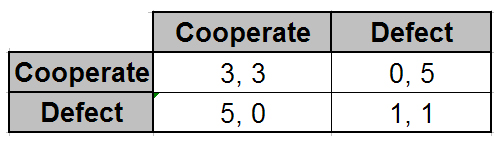
The programs in the tournament went through thousands of rounds and added the results of each of them to determine which program had the highest score and therefore had the best strategy.
The winner, by a longshot, engage in a tit-for-tat strategy. If it had never encountered the other player before, it would start the first round by cooperating, and then it would copy the other player's last move and play it against him the next round. Therefore, it punished players that defected against it by defecting against them while rewarding players who favored cooperation by cooperating with them.
Emergent Cooperative Gameplay
Humans act remarkably similar to how the winning program acted. If you take into account that the Prisoner's Dilemma is a situation often encountered among organisms vying over limited resources and that humans are the top of the food chain, this should be unsurprising. Other studies of IPD among people rather than simulations show that humans tend to favor tit-for-tat with forgiveness, in that even if the other player defects against them there's still a chance they'll cooperate anyway in the hope that they can continue to cooperate.
Remember, if two tit-for-tat programs meet in a game of Prisoner's Dilemma, they will invariably cooperate with one another and wrack up more points than programs that defect. Put two human players together than over time they will learn from previous mistakes and see other strategies that may work better than theirs and adopt them. Thus, they tend to adopt a tit-for-tat with forgiveness. However, since all players do not always change their tactics, tit-for-tat still gives players protection from defecting players by defecting against them.
Getting players to change their strategy from competitive to cooperative over time is the emergent cooperative gameplay at the heart of this Master's project.