About
"Emergent Cooperative Gameplay" is the title of a 2008 Master's thesis written and developed by Liz England while attending the Guildhall program at Southern Methodist University.Download the Game

the Gamer's Dilemma
- Requires 2 Players
- Works Best with Controllers
Online Abstract
Full Master's Thesis


Contact
lizengland07[at]gmail.com
Part 2: The Prisoner's Dilemma
What is the Prisoner's Dilemma?
The Prisoner's Dilemma is a famous mathematical game in which two people must each make one of two choices, and the outcome is determined based on what both people chose. It's called the Prisoner's Dilemma because it's most commonly told in variations of the following story:
Bonnie and Clyde have been caught by the police, their long crime spree finally at an end. An officer offers each of them a plea deal: if they will testify against their friend, they'll go free and their friend will undoubtedly be sentenced to 10 years in prison. But Bonnie and Clyde know that if they both rat each other out, neither of them goes free and they both serve five years in jail. To make matters worse, if they remain silent about the other person, they'll each get 6 months due to lack of evidence.
Separated in different rooms, they have no way to communicate with one another. So what do Bonnie and Clyde do? The only way they get out of prison entirely is if they rat the other person out, but if they both rat each other out they are worse off than if they just stayed silent.
So both Bonnie and Clyde have the same choices, and have to make their choice in isolation, but what they get out of it depends just as much on the other person's choice as on their own.
The Decision Matrix
The choices are commonly illustrated in a decision matrix that shows all possible outcomes.
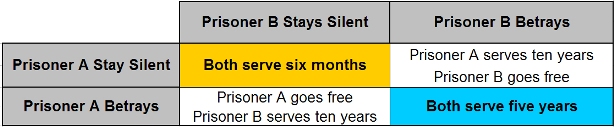
The Prisoner's Dilemma Decision Matrix
When comparing your choices, a rational player will choose to betray: the risk is smaller (five years instead of ten years in prison) and the reward is greater (get out of jail free as opposed to six months). When it comes to making a decision without communicating with the other person, the player is personally always better off betraying the other prisoner. Betrayal is the dominant strategy.
But when both players are rational, they both betray one another and both end up serving five years (highlighted in blue), while trusting and cooperating against each other would only give them six months in prison (highlighted in orange).
About 70% of people who play the Prisoner's Dilemma betray the other person.